How Property Tax Is Actually Calculated: Mill Rates, Assessments, and Appeals
Property tax rates rarely tell the whole story. Here's how assessed value, mill rates, and exemptions actually combine to produce your bill, and what you can do if you think yours is too high.
This article provides general educational information only and is not tax, legal, or financial advice. Property tax rules vary significantly by state and even by county. Confirm the rules that apply in your specific area with your local assessor's office or a qualified adviser.
You look up the property tax rate for your town. You do the math in your head. Then your actual bill shows up, and the number is different from what you expected.
This happens to a lot of people, and it's rarely a mistake. Property tax isn't one simple number. It's built from several separate pieces, and missing even one of them is enough to throw off your own estimate. Once you know what those pieces are, the math makes a lot more sense, and so does your bill.
The three pieces of your bill
In many U.S. jurisdictions, property tax bills are built from the same three ingredients.
The first is your home's assessed value. This is a number a local assessor's office assigns to your property for tax purposes. It is not the same as what your home would sell for today, and that gap is the source of a lot of confusion, which we'll get into next.
The second is the tax rate, often called a mill rate. This is usually written as an amount per $1,000 of value. A rate of $20 per $1,000 means you owe $20 in tax for every $1,000 of taxable value.
The third is any exemption you qualify for. A homestead exemption, a senior exemption, or a veteran exemption all work the same basic way: they reduce the taxable value of your home before the rate gets applied, which lowers your final bill.
Put those three together and you have your tax bill. The catch is that each piece can shift on its own, and your total can change even when one or two of them stay exactly the same.
Assessed value isn't market value
This is the part that trips up the most homeowners, so it's worth sitting with for a moment.
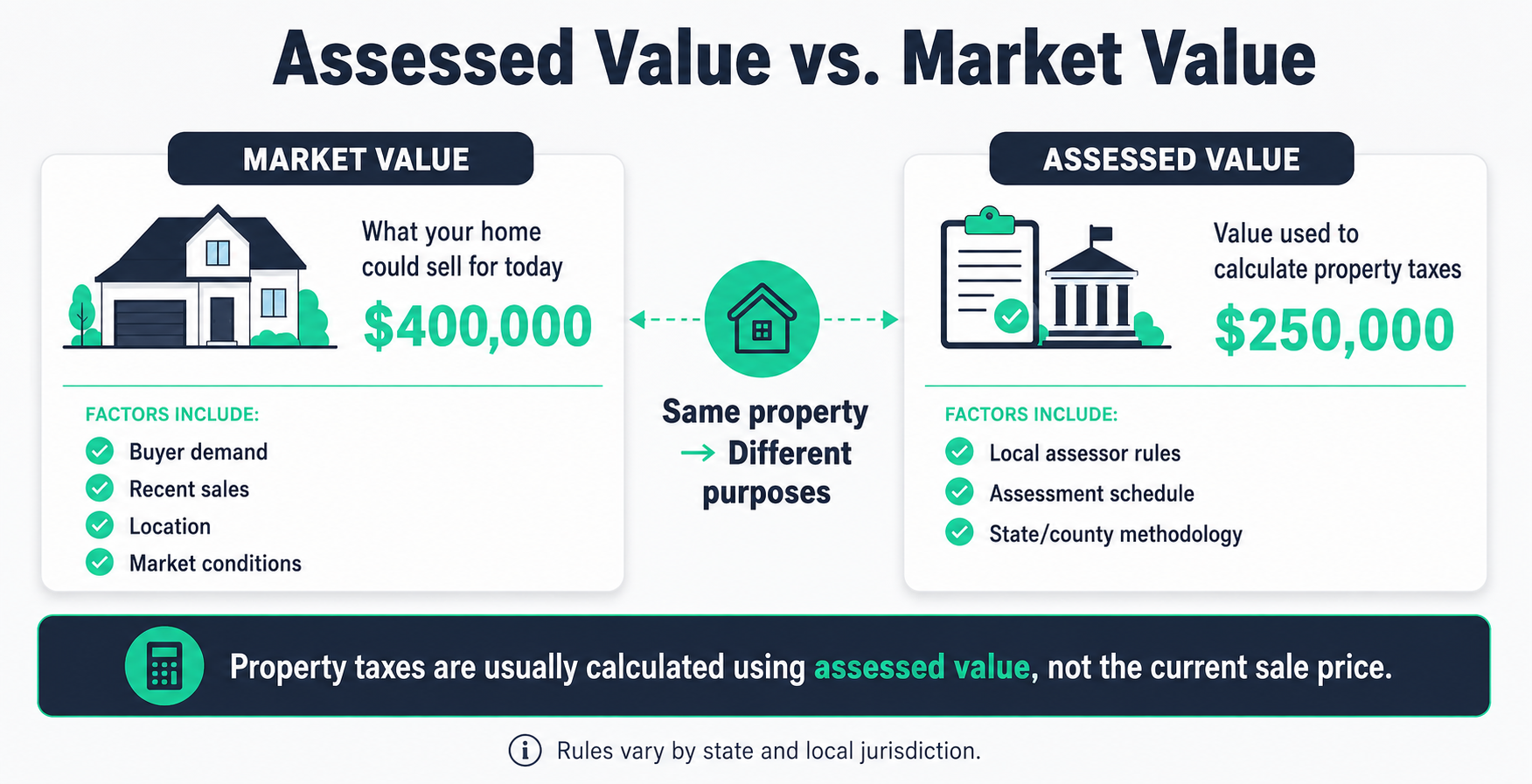
Assessed value is an estimate set by a local official, often based on a past review cycle rather than today's market. If your area hasn't done a full reassessment in a few years, your assessed value can lag well behind what homes are actually selling for right now.
This explains a few things that otherwise seem strange. Two nearby homes that sold for very different prices can carry similar assessed values, if neither has been reassessed since the market shifted. A home in a fast-rising neighborhood can have a tax bill that feels low compared to its real worth, simply because the assessment hasn't caught up yet. And when a reassessment finally happens, a bill can jump noticeably even if the tax rate itself never changed.
None of this means anyone made an error. It just means assessed value and market value are two different numbers that are allowed to drift apart, sometimes for years at a time.
Why states calculate this differently
On top of all this, different states and even different agencies within the same state can calculate their rates on a slightly different basis. Some apply the rate directly to assessed value. Others convert everything to an estimate of full market value first, then apply the rate to that instead.
Neither approach is wrong. They're just two different methods for getting to a fair number. The practical lesson is simple: if you're ever comparing two property tax figures, whether it's your own town across two different years, or your town against a neighboring one, make sure both numbers are using the same method. Comparing a rate based on assessed value to a rate based on full value is a bit like comparing a price in two different currencies. The numbers can look very different even when the real difference is small, or there isn't one at all.
The actual math
Here's how the calculation works once you have all the pieces.
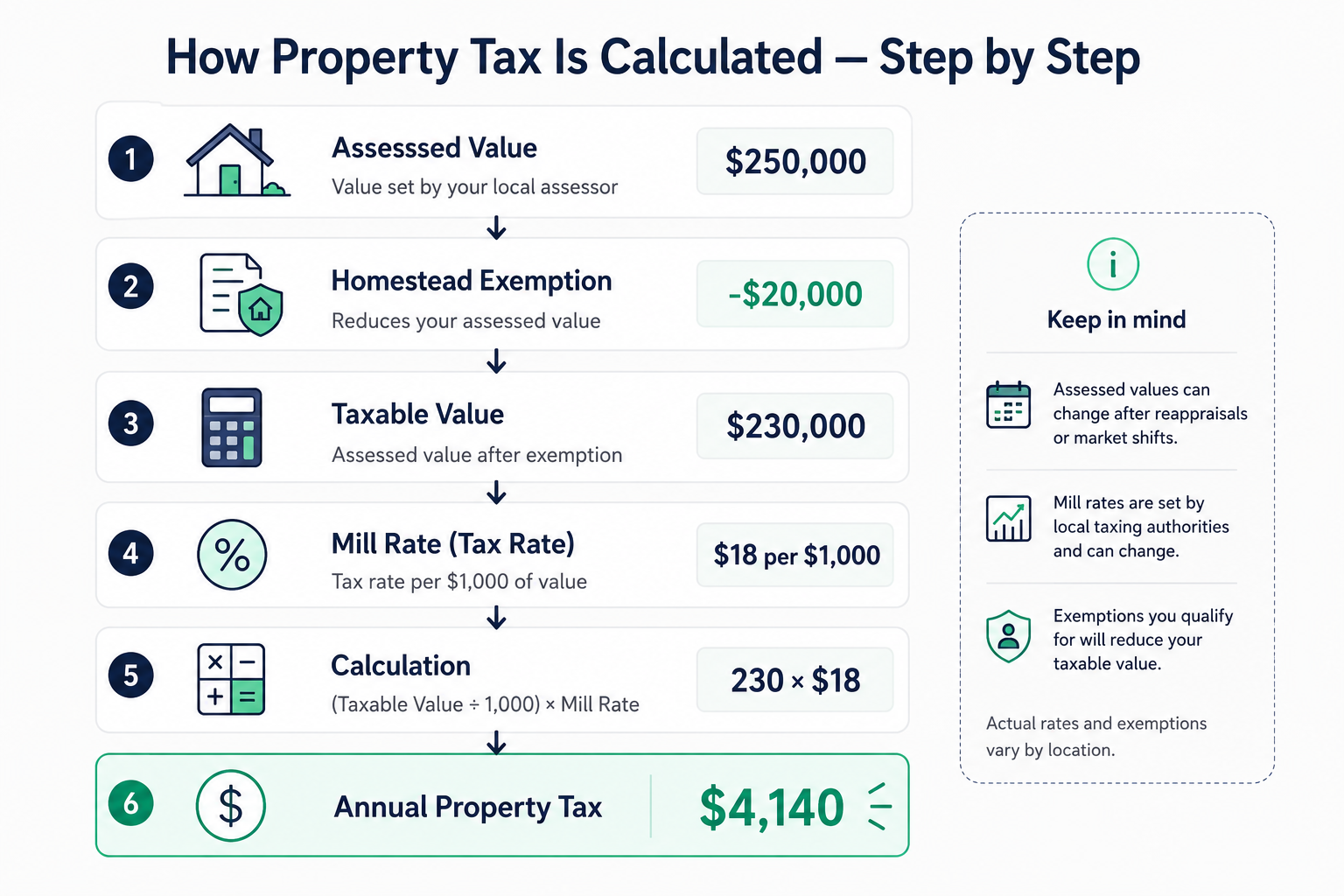
Say your home has an assessed value of $250,000, and your local tax rate is $18 per $1,000 of value.
Divide $250,000 by 1,000, which gives you 250. Multiply that by $18, and you get $4,500. That's your property tax for the year, before any exemptions.
Now say you qualify for a $20,000 homestead exemption. Subtract that from your assessed value first: $250,000 minus $20,000 leaves $230,000 in taxable value. Run that same math again, 230 times $18, and your bill drops to $4,140.
That's the entire calculation. The part that actually causes confusion isn't the math, it's figuring out which assessed value, which rate, and which exemptions apply to your specific property.
Why your bill can change every year, even if your home's value doesn't
Here's something a lot of people don't expect. Your home's assessed value can stay exactly the same, and your tax bill can still go up.
That's because the number most people picture as one rate is usually three rates stacked together: a municipal or town rate, a county rate, and a school district rate. School district rates are often the largest of the three, since schools make up a big part of local government spending.
If your town holds its own rate steady, but the school district raises its budget and its rate along with it, your total bill rises even though nothing about your home changed and the town did nothing differently. This is one of the more common reasons people feel confused or even frustrated by a rising bill that doesn't seem to match anything they did. In most cases, it has nothing to do with your home at all. It has to do with a budget decision made somewhere else on your bill.
How to appeal your assessment
If you believe your assessed value is too high, most places let you formally challenge it. The exact process varies by state and even by county, so treat this as a general guide, not a step-by-step for your specific area.
Generally, you'll need to act within a set filing window, often shortly after assessment notices go out each year. You'll also want evidence. The strongest kind is usually recent sale prices of similar homes nearby, ones with a comparable size, age, and condition to yours. An independent appraisal can help too. You can also raise errors in the assessor's own records, incorrect square footage, wrong number of bedrooms, or a condition rating that doesn't match the property's actual state, these are common and often successful grounds for appeal. Most areas start with a local review board before any further step, and many cases are resolved at that stage without needing to go further.
Common reasons appeals fail. A few mistakes come up again and again. Using your home's own recent sale price as your only evidence usually doesn't help, since assessors already expect some gap between a sale price and assessed value, and that alone isn't proof of an error. Comparing your home to properties that aren't truly similar, a much newer house, a different size, a different neighborhood, weakens your case. And missing the filing deadline ends things before they start, no matter how strong your evidence might have been.
It also helps to know that winning an appeal lowers your assessed value, not your tax rate. The rate stays whatever your town, county, and school district set it at. What changes is the number that rate gets applied to. For most homeowners, that's still a meaningful win, since a lower assessed value carries through to every future year until the next reassessment, not just the one year you appealed.
Quick answers
Does refinancing affect your property tax? Refinancing your mortgage does not, by itself, trigger a reassessment in most places. Property tax assessments are usually tied to ownership and physical changes to the property, not to how you finance it.
Does buying a home increase the tax bill? It can. In many areas, a sale can trigger a reassessment, since the sale price gives the assessor's office a fresh data point. This is one reason a new owner sometimes sees a different tax bill than the previous owner had, even with no other changes to the property.
Can property taxes go down? Yes. If your local government lowers its budget, if your area's overall property values drop and assessments are adjusted to match, or if you successfully appeal an assessment, your bill can decrease. It's less common than an increase, but it does happen.
Are property taxes deductible? Under current federal law, taxpayers who itemize deductions can deduct state and local taxes, including property tax, but this deduction is subject to an annual cap under the SALT (state and local tax) limitation. This is a general note, not tax advice for your specific situation. A tax professional can tell you exactly how it applies to you.
Does adding a deck or finishing a basement raise your assessment? Often, yes, eventually. Many areas require a permit for major additions or renovations, and permits tend to flag a property for reassessment at some point. This doesn't always happen immediately, but it's common enough that homeowners planning a large renovation should expect their assessment to catch up with the work at some point down the line.
If you want to get a sense of your own number before reviewing an assessment notice, our Property Tax Estimator uses county-level data to give you a starting estimate. It won't replace your actual assessment, but it's a reasonable place to begin.