Inheritance Tax vs Estate Tax: What's the Real Difference?
Most people use these two terms as if they mean the same thing. They don't. Here's who actually pays each one, which states have which tax, and what it means if you live somewhere with neither.
This article provides general educational information only and is not tax, legal, or financial advice. Tax laws change, and rules vary significantly by state. Confirm current figures with the IRS or a qualified adviser before making any decisions.
Most people use "inheritance tax" and "estate tax" as if they're the same thing. They get mixed up all the time, in conversation and online, and it's an easy mistake to make. But they're actually two different taxes, and the difference matters, because it changes who owes money and how much.
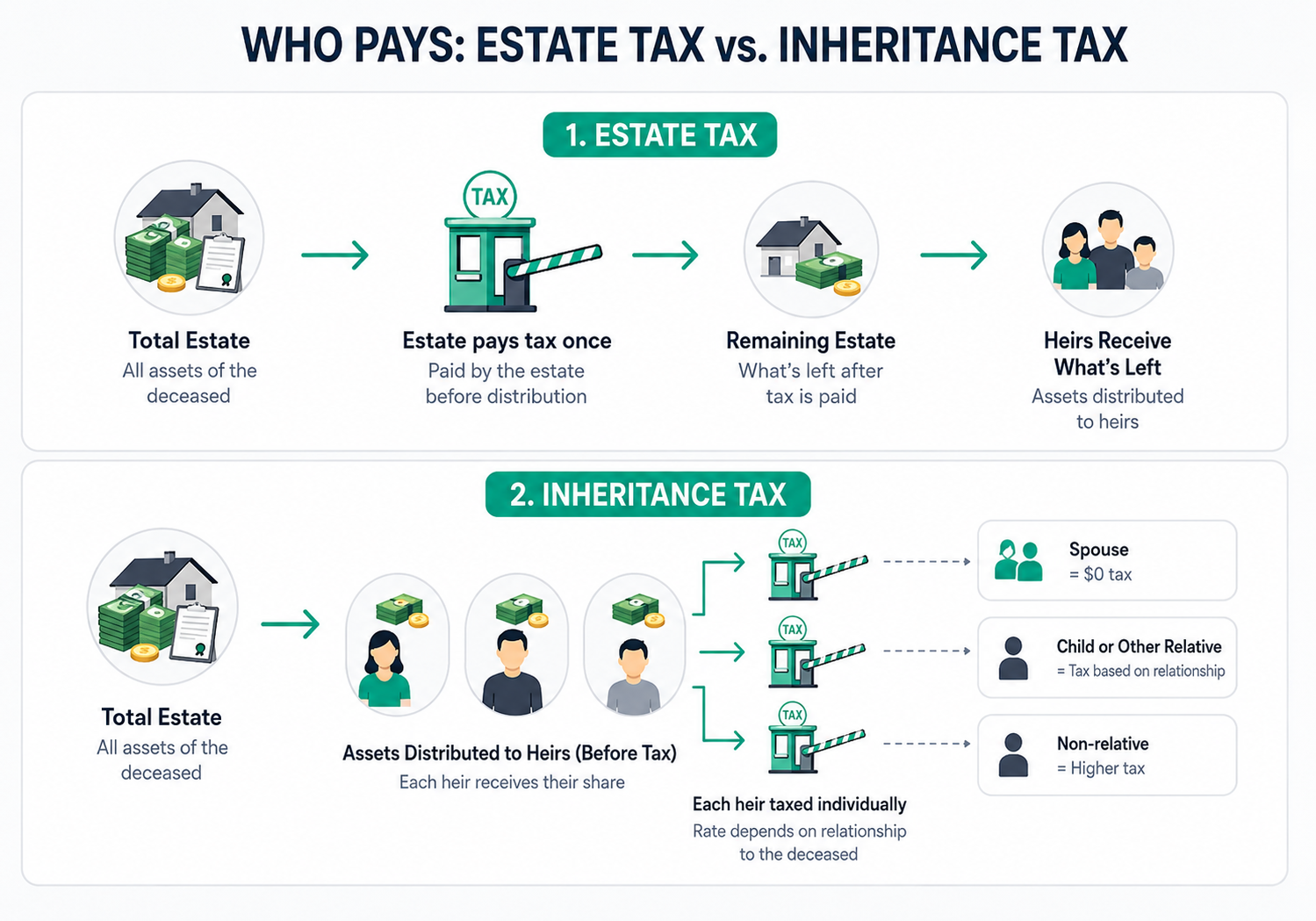
Here's the one sentence that explains it. Estate tax is paid by the estate itself, before anything gets handed out, based on everything the person who died owned. Inheritance tax is paid by each person who inherits, based on what they personally received and how they were related to that person.
Once you have that distinction in your head, the rest of this gets a lot easier to follow.
Estate tax: who pays it
Estate tax looks at the full value of everything someone owned when they died, their home, their savings, their investments, and anything else, added together. The tax, if any is owed, comes out of the estate before the remaining assets are passed to anyone.
At the federal level, this tax only applies to very large estates. For 2026, an individual's estate has to be worth more than $15 million before federal estate tax applies at all. For a married couple, using a rule called portability, that combined exemption is $30 million. This exemption is adjusted periodically for inflation and can change with new legislation, so confirm the current amount with the IRS before relying on it. Because the exemption is so high, only a very small percentage of estates in the country actually owe federal estate tax.
A total of 12 states also have their own, separate estate tax on top of the federal one. These state-level exemptions are usually much lower than the federal amount, so it's possible for an estate to owe a state estate tax even though it's nowhere near large enough to owe the federal one.
Inheritance tax: who pays it
Inheritance tax works completely differently. It doesn't look at the size of the whole estate. It looks at what you personally received, and your relationship to the person who left it to you.
Only five states currently have an inheritance tax: Pennsylvania, New Jersey, Kentucky, Nebraska, and Maryland. In every one of them, a surviving spouse is fully exempt, no matter how much they inherit. Beyond that, the rules vary quite a bit by state, but the pattern is usually the same: close relatives pay the least, often nothing, and people who aren't closely related pay the most.
Imagine someone leaves $50,000 to two different people in a state with an inheritance tax.
If it goes to their spouse, the tax is $0. Spouses are exempt everywhere this tax exists.
If the same $50,000 goes to a close friend who isn't a relative, the tax could run into the thousands of dollars, depending on the state's specific rate for unrelated beneficiaries. Same amount of money, same estate, very different outcome, because inheritance tax cares about who you are to the person who passed away, not just how much you received.
Which states have which tax
It helps to separate this clearly, since the two taxes don't follow the same map.
The five inheritance tax states are Pennsylvania, New Jersey, Kentucky, Nebraska, and Maryland. If you don't live in, and don't inherit property from, one of these five states, you won't owe state inheritance tax.
It's also worth noting that New Jersey no longer has a state estate tax, which it repealed effective January 1, 2018, but it continues to impose an inheritance tax on certain beneficiaries. The two are separate, and NJ's elimination of its estate tax did not affect its inheritance tax.
A total of 12 states have their own state-level estate tax, with exemption amounts well below the federal $15 million threshold. Maryland is one of them, making it the only state in the country that enforces both taxes simultaneously.
Most states, including large ones like California and Texas, have neither tax. If you live in one of these states, you can still owe federal estate tax if the estate is large enough, but you will not owe a state-level inheritance or estate tax on top of it.
It's also worth knowing that the five inheritance tax states don't all work the same way. Pennsylvania, for example, taxes most lineal descendants like adult children at a flat 4.5%, with no dollar exemption before that rate kicks in. New Jersey takes a different approach for more distant relatives, applying graduated rates that climb as the inherited amount grows. Nebraska collects this tax at the county level rather than statewide, even though the rates themselves are set by state law. None of these differences change the basic pattern, spouses are exempt, closer relatives generally pay less, but they're a reminder that "inheritance tax" isn't one uniform rule repeated five times. Each state built its own version.
Maryland: the one state with both
Maryland is the only state in the country that has both its own estate tax and an inheritance tax, applying to the same estate at the same time.
This sounds like it could mean paying twice on the same money, but that's not quite how it works. Inheritance tax paid is generally credited against any estate tax owed, so the two don't simply stack on top of each other without any offset. Even so, Maryland residents have more to think about than residents of most other states, since both taxes need to be considered, not just one.
What if your state has neither tax?
This is the situation most people are actually in, since 45 states have no inheritance tax, and most states have no separate estate tax either. But "my state doesn't have this tax" isn't always the end of the story. Two things can still apply to you, regardless of where you live.
The first is federal estate tax, which applies in every state, but again, only to very large estates above the federal exemption.
The second is easy to miss. If you inherit property, especially real estate, from someone who lived in or owned property in one of the five inheritance tax states, that state's tax can apply to you, even if you live somewhere else entirely.
Picture someone living in Texas, a state with no inheritance tax at all. Their aunt, who lived in New Jersey, leaves them a house.
Even though the inheriting relative lives in Texas, New Jersey's inheritance tax can still apply, because the tax follows where the deceased person lived and where the property is located, not where the person receiving it lives. Living in a state with no inheritance tax doesn't automatically protect you if the person you're inheriting from lived somewhere that does have one.
Can you reduce what's owed?
This comes up a lot, so it's worth addressing directly, without turning it into individual advice, since the right approach depends heavily on someone's specific situation.
People often look into tools like trusts, gifting assets while still alive, or the marital deduction, which lets assets pass to a spouse without estate tax. Certain irrevocable trusts may remove assets from a taxable estate if established and administered correctly, but many trusts do not reduce estate tax, and their effect depends entirely on the trust structure and applicable tax rules. Gifting works on a similar idea, giving assets away during life, within annual limits set by the IRS, rather than waiting to pass them on after death. The marital deduction is more straightforward: it generally allows an unlimited amount to pass to a surviving spouse without triggering federal estate tax, though that doesn't always mean no tax will ever be owed, since it can simply shift the question to when the second spouse passes away.
These are real, commonly used strategies, and they can reduce what's eventually owed in some situations. But none of them automatically eliminates tax for everyone, and using them well usually depends on the size of the estate, the state involved, and the specific people inheriting. If a meaningful amount of money is involved, this is exactly the kind of decision worth bringing to an estate attorney or tax professional, since the details matter a great deal here.
The bottom line
When you're trying to sort out which tax might apply, two questions do most of the work. Whose money is actually being taxed, the estate's, or the person who received it? And where did the person who passed away live, or own property?
Answer those two questions, and you'll usually know right away whether you're dealing with estate tax, inheritance tax, both, or neither.
State tax laws vary significantly. If you're dealing with a real estate, confirm the rules that apply in your specific state with a qualified adviser.
If you want to check a specific state and relationship, our Inheritance Tax Calculator covers all five inheritance tax states, along with the federal estate tax, so you can get a starting estimate based on your own situation.